
Introduction: Why trust matters in digital signing
Every day, we click “Sign” on documents without much hesitation. For businesses, a signature is more than a click. It is evidence of consent, identity, document integrity, and accountability. If any part of that trust chain is weak, the signed document may become difficult to verify, audit, or defend later.
Behind that single action is a trust system that ensures:
- The signer is verified
- The document has not been altered
- The signature can be validated across systems and organizations
So the real question is:
What actually makes a digital signature trustworthy?
Common Misconceptions About Digital Signatures
Before diving into the technical details, consider these questions:
🤔 Is a digital signature simply an image of a handwritten signature?
🤔 Is password-protecting a PDF the same as digitally signing it?
🤔 Who decides whether a digital certificate can be trusted?
🤔 If a document says “Signed”, how can we verify who actually signed it?
🤔 What prevents someone from modifying a document after it has been signed?
🤔 What role does PKI actually play in all of this?
At this point, a natural question emerges:
If these common assumptions are incorrect, what actually makes a digital signature trustworthy?
These questions may seem simple, but answering them requires understanding the trust framework operating behind every digital signature. To answer that, we need to understand the relationship between digital certificates, digital signatures, and PKI.
Digital Certificate vs Digital Signature
A common misunderstanding is treating digital certificates and digital signatures as the same thing. In reality, they serve different roles in the system.
| Concept | Role in System |
| Digital Certificate | Identity binding |
| Digital Signature | Action + integrity proof |
Practical Interpretation
- A digital certificate defines who the user is in a trusted system
- A digital signature proves the user performed an action on a specific document
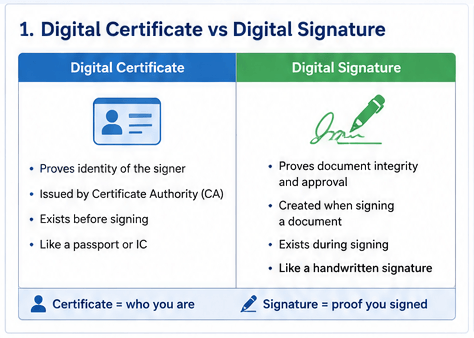
Key Distinction
- Certificate = identity layer
- Signature = transaction layer
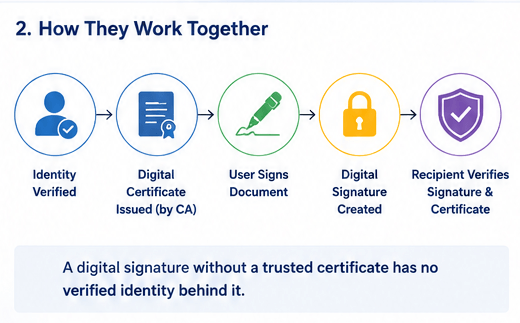
Without certificates, signatures have no trusted identity behind them.
Without signatures, certificates cannot prove document-level actions.
Where PKI Fits In
To understand trust in a scalable system, we need to understand how certificates are issued and trusted. This is handled by Public Key Infrastructure (PKI).
What PKI Provides
PKI is the framework responsible for:
- Issuing digital certificates
- Binding identities to cryptographic keys
- Managing trust relationships between entities
- Enabling verification of signatures across systems
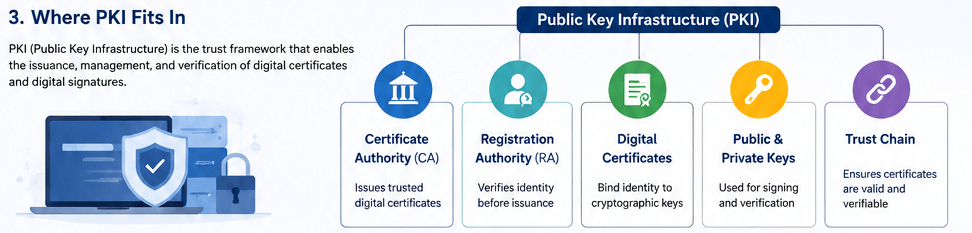
PKI is the trust backbone that allows digital certificates to be meaningful outside a single system.
Without PKI, certificates would have no external validity.
Chain of Trust
Digital trust does not originate from a single entity. It is established through a hierarchical trust model.
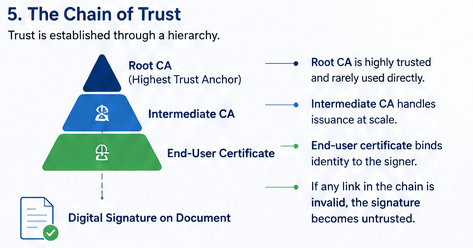
Why This Matters
- Root CA establishes global trust anchor
- Intermediate CA distributes trust at scale
- End-user certificates bind signing action to verified users, organization, or system.
Any break in this chain invalidates trust in the signature.
Where PKI Becomes Critical in Real Systems
In enterprise systems like digital signing platforms:
- PKI ensures certificates are trusted across organizations
- CA policies define trust rules
- Certificate validation ensures signed documents are reliable
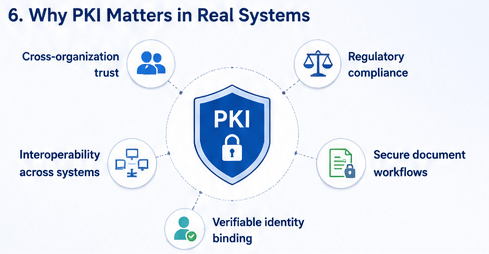
PKI is what allows digital signatures to be trusted beyond one platform, one company, or one system.
Revisiting the Myths
Now that we’ve explored digital certificates, digital signatures, and PKI, let’s revisit the questions from the beginning.
- Is a digital signature simply an image of a handwritten signature?
No. A digital signature is cryptographic proof generated using a private key and validated through a trusted certificate. The visual appearance is only a representation of the signature.
- Is password-protecting a PDF the same as digitally signing it?
No. A password controls access to a document. A digital signature provides identity verification, integrity protection, and non-repudiation.
- Who decides whether a digital certificate can be trusted?
Trust is established through PKI and the certificate chain, beginning with trusted Root Certificate Authorities.
- If a document says “Signed”, how can we verify who actually signed it?
The digital certificate embedded in the signature links the signing action to a verified identity.
- What prevents someone from modifying a document after it has been signed?
The document hash embedded within the signature changes immediately if the document is altered, causing signature validation to fail.
- What role does PKI actually play in all of this?
PKI provides the trust framework that enables certificates, signatures, and verification mechanisms to work together.
How SignDex Supports Digital Trust
SignDex is designed around this trust model. By using digital certificates, trusted Certificate Authorities, and standards-based digital signing, SignDex helps organizations create documents that are not only signed, but also verifiable, tamper-evident, and suitable for audit and compliance workflows.
Final Takeaway
A trustworthy digital signature is not just a visual mark on a PDF. It is the result of verified identity, cryptographic protection, certificate trust, and long-term validation.
For organizations, understanding this trust system is important when choosing a digital signing platform — because the real value of a signature is not just that it was placed, but that it can be trusted later.
See how SignDex implements this trust model — request a demo at SignDex.io